|
The city of Dawn, Udaipur is a lovely land around the azure water lake, hemmed in by the lush hills of the Aravallis. A vision in white drenched in romance and beauty, Udaipur is a fascinating blend
of sights, sound and experiences and inspiration for the imagination of poets, painters and writers. Its kaleidoscope of fairy-tale palaces, lakes, temples, gardens and narrow lanes strewn with stalls,
carry the flavor of a heroic past, epitomizing valour and chivalry. Their reflection in the placid waters of the Lake Pichhola is an enticing sight. Udaipur is the jewel of Mewar-a kingdom ruled by the
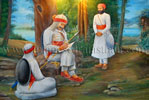
Sisodia dynasty for 1200 Years. The foundation of the city has an interesting legend associated with it. According to it, Maharana Udai Singh, the founder, was hunting one day when he met a holy man
meditations on a hill overlooking the Lake Pichhola. The hermit blessed the Maharana and advised him to build a palace at this favorable located spot with a fertile valley watered by the stream, a lake,
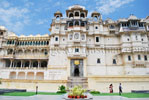
an agreeable altitude and an amphitheatre of low mountains. Maharana followed the advise of the hermit and founded the city in 1559 A.D. Overlooking the aquamarine expanses of the Lake Pichhola stands
the splendid City Palace-a marvel in granite and marble. Of the original eleven gates of the Udaipur City, only five remain. The Suraj Pol the original or Sun Gate on the eastern side is the main
entrance to the city. Exquisite lake palaces of Udaipur shimmering like jewels on Lake Pichhola are overwhelming in splendor. Several places of interest around Udaipur, including the majestic, Chittaurgarh,
the mountain fortress of Kumbhalgarh, beautiful Jain temple of Ranakpur, Eklingji and Nathdwara and the cool retreat of Mt. Abu, make the visit to Udaipur a memorable one.
TOP
PLACES OF INTEREST ARE:
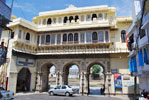
City Palace: A majestic architectural marvel towering over the lake on a hill surrounded by crenellated walls, it is a conglomeration of courtyards, pavilions, terraces, corridors, rooms and
hanging gardens.
The main entrance is through the triple arched gate, the 'Tripolia' with eight marble porticos. The Maharana were weighed under the gate in the gold, the equivalent amount of which was distributed
among the populace.
The Suraj Gokhada, the balcony of the sun, is where the Suryavanshi Maharanas of Mewar presented themselves to the people in time of trouble to restore their confidence. The 'Mor Chowk'
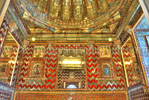
known for its exquisite peacock mosaics in glass and the 'Chini Chitrashala' noted for its blue and white ceramics are other attractions in the palace.
Lake Pichhola: The picturesque lake that entranced Maharaja Udai Singh. It was later enlarged by the founder. The lake is surrounded by hills, palaces, temples, bathing ghats and
embankments. Two island palaces, Jag Mandir and Jag Niwas (Lake Palace) on the lake are of breathtaking.
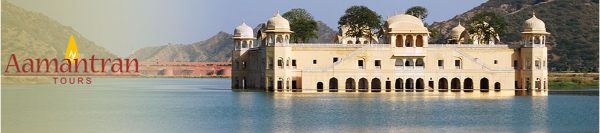
Jag Mandir: In the middle of Lake Pichola is the island palace where Prince Khurram (Shah Jahan) sought refuge from his father, the Emperor Jehangir.
Jag Mandir (1651 AD) with its tower of yellow sandstone is lined within with marble. it is three stories in height and is capped by a dome and the flooring is done is striking back and white marble tiles.
The temple with the palace precints is dedicated to the Lord of the World and is named after him.
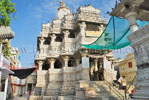
Jagdeesh Temple: The temple of Jagannath Rai, now called Jagdishji, is a major monument of and should be seen carefully. Raised on a tall terrace and completed in 1651, it is a tribute alike to the
tenacity of its builders and the resilience of the art tradition in represents. It attaches a double storied Mandapa (hall) to a double storied, Saandhara (that having a covered ambulatory) sanctum.
The Mandapa has another storey tucked within its pyramidal Samavarna (bell roof) while the hollow clustered spire over the sanctum contains two more, non-functional, stories. Lanes taking off from many
of the gates of the Sheharpanah (city wall) converge on the Jagdish Temple and walking leisurely through them brings you face to face with the many layers of the cultural palimpsest that Udaipur is.
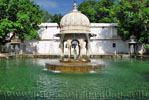
Saheliyon-ki-Bari: This small ornamental garden was a popular relaxing spot where royal ladies came for a stroll and hence the name. The garden has many fountains in its four delightful pools,
chiseled kiosks and marble elephants.
Gulab Bagh: A spectacular rose garden laid out by Maharana Sajjan Singh. A library in the garden has a rare collection of ancient handwritten manuscripts and books.
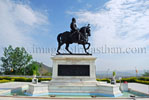
Pratap Memorial: Atop the Moti Magri or pearl hill, overlooking the Fateh Sagar Lake is the memorial of the Rajput hero Maharana Pratap with a bronze statue of the Maharana.
Fateh Sagar: A beautiful lake, overlooked by a number of hills on the three sides and the Pratap Memorial on the north was built by Maharana Fateh Singh. In the middle of the lake is Nehru Park-a
lovely garden island with a boat shaped cafe accessible by an enjoyable boat ride.
Sajjan Garh: Dominating the city's skyline is the monsoon palace of Sajjangarh. It offers a panoramic overview of the city's lakes, palaces and the surrounding countryside.
Ahar: The ancient capital of Sisodias, 3 km from Udaipur, Ahar boasts of a profusion of royal cenotaphs of the rulers of Mewar. A rare collection of antiquities including earthen pots, iron objects
and other art items excavated in the region are displayed in a small Govt. museum.
Bagore Ki Haveli: Situated on the bank of Lake Pichola & incorporating the majestic Gangaur Ghat, this haveli was built by the then Prime Minister of Mewar in the second half of the 18th century.
The property fell into a dilapidated state until restoration by the West Zone Culture Centre began in 1986. There are 138 rooms, balconies, courtyards & terraces. The Chambers of the Royal Ladies
contain fine fresco paintings, and the glass & mirror inlay work in the Haveli is marvelous.
TOP
MUSEUMS & ART GALLERIES:
Archaeological Museum, Ahar: The museum at Ahar has a varied collection of findings from excavations at the mount of Dhulkot. It is believed to be the site of 4,000 year old township. The major
exhibits of the museum are the Skim scrubber (1st century BC) seals (1st century BC) grain pot (1st century BC) animal figures, stone weights and balls. Some beautiful Hindu and Jain icons are displayed
in one gallery, the most prominent being the metallic image of the Jain Trithankara (saint). Among the collection of sculptures, there is a statue of Vishnu-Nag-Nathan
belonging to the medieval period in which snakes are enwinding all around the deity.
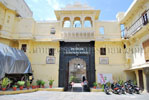
City Palace Museum: The huge City Palace, towering over the Pichola Lake, is the largest palace complex in Rajasthan. Construction of this palace was started by Maharana Udai Singh, the founder of
city. The main part of the palace is now preserved as a museum with a large and varied collection. It was established in 1890 and is one of the earliest museums of the state. The museum includes the Mor
Chowk with its beautiful peacocks in mosaics. The Manak (Ruby) Mahal has glass and porcelain figures while Krishna Vilas has a remarkable collection of miniatures. Bhim Vilas has a boldly striped floor
and scenes from the Radha-Krishna stories are painted on the walls. In the Bari Mahal, there is fine central garden. More paintings can be seen in the Zenana Mahal. The Moti Mahal has beautiful mirror
work and the Chini Mahal is covered in ornamental tiles. The museum has the armour of Maharana Pratap and the drums and bugles of the ruler of Mewar, Rana Sanga.
Crystal Gallery: The Crystal Gallery located in Fateh Prakash Palace (part of the Grand City Palace Complex) was opened to the public in 1994. Overlooking the Durbar Hall, the Crystal Gallery has a
grand collection of more than 600 rare objects collected from different parts of the world. inspired by the showroom of the Birmingham based company F&C Osler in Calcutta, this unique collection of the
gallery was ordered by Maharana Sajjan Singhji in the year 1877. From lamps to washing bowls, perfume bottles to paperweights & writing instruments, the collection has it all. The Crystal Gallery
also boasts a crystal bed, the only one of its kind in the world. Besides these, other fascinating objects include a sofa-set, a dining table, fountains, various coloured crystal objects, mirrored
tabletops, exquisite decanters & a fabulous jewel-encrusted carpet.
Government Museum: The Government Museum of Udaipur was originally located in Gulab Bagh and was called the Victoria Hall Museum. It has now been shifted to Karan Vials Mahal within the precincts
of the City Palace. This museum highlights the culture and heritage of Rajasthan through its extensive collection of excavated and handicrafts. The inscriptions exhibited at eh museum range from those
of 2nd century BC to 17th century AD. The antiquities of the plastic art of Mewar add to the attraction. The sculpture gallery, spread over a big hall, contains some unique and valuable specimens.
Inscriptions exhibited at the museum date back to as early as 200 BC. The most remarkable collection is that of more than nine thousand miniature paintings of Mewar School from the period of Maharana
Jagat Singh (1628 - 1652 AD) to Maharana Swaroop Singh (1842 - 1861 AD). It has a Natural History section called the Children Gallery which has models of animals like tiger, deer etc. the museum also
has collection of colourful Mewari turbans.
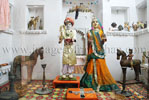
Bharatiya Lok Kala Musuem: The interesting collection exhibited by this Indian folk arts museum includes folk dresses, ornaments, puppets, masks, dolls, folk musical instruments, folk
deities and paintings and the high point of the exhibits puppets.
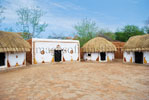
Shilp Gram: It is located on Fateh Sagar, 6 km from the City Palace. A village has been created with 26 replica huts. This museum has a wide collection of folk art and it also gives a glimpse of
the tribal life of Rajasthan.
TOP
EXCURSIONS:
Nagda (23 km): The ancient site dating back to the 6th century A.D. is renowned for the Sas-Bahu temples (9t - 10th century A.D.) with interesting architecture and carvings. The
splendid Jain temples of Adbudji are also worth a visit.
Haldighati (40 km): A historical site, witness to the great battle fought between Maharana Pratap and Mughal Emperor Akbar in 1576 A.D. The Chhatri of Maharana's horse-Chetak is noteworthy.
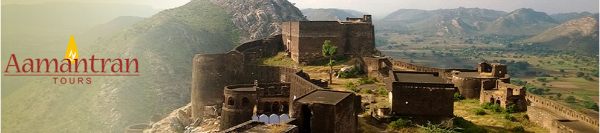
Kumbhalgarh Fort (84 km): The second principal fortress in Rajasthan after Chittaurgarh, it is perched atop the Aravallis. Built in the 15th century by Maharana Kumbha, it extends over 12 km and
enclose many temples, palaces and gardens. The fort renovated in the 19th century. The Badal Mahal or Cloud Palace offers a spectacular bird's eye view of the surrounding countryside. Close by is the
Kumbhalgarh Wildlife Sanctuary with a rich variety of wildlife. The Fort is accessible only by jeep from Kelwara through the seven gates.
Jagat (58 km): The splendid and well preserved 10th century temple of Ambika Mata is known for its intricate carvings in the outer walls. Popularly known as the Khajuraho of Rajasthan.
Jaisamand Lake (48 km): A stunningly situated artificial lake, built in the 17th century A.D. by Maharana Jai Singh is the second largest in Asia. Graceful marble Chhatris flank the embankment and
beautiful summer palaces of the Udaipur queens are built on either side of the lake. Jaisamand Island Resort is also worth visiting.
A trip to Jaisamand Wildlife Sanctuary allows a close encounter with the rich wildlife in their natural habitat. The fauna includes panther, wild boar, deer, four honed antelope, mongoose and
various species of migratory birds.
Ranakpur (90 km): The beautifully sculptured Jain temples lie in a tranquil valley of the Aravallis. The main 'Chaumukha Temple' is dedicated to the Tirthankara Adinath and has 29 halls supported
by 1444 pillars, all distinctly carved. Two Jain temples dedicated to Neminath and Parsvanath and a Sun Temple a little distance away, are also noteworthy.
Nathdwara (48 km): The most revered 17th century shrine, dedicated Shrinathji or Lord Krishna, attracts thousands of Pilgrims from all over the country, especially during Diwali, Holi and
Janmashtami when their number exceeds a lakh. Foreign tourists are not permitted inside and photography is prohibited.
Kankroli (65 km): An important Vaishnava temple popularly called Dwarikadish. It is the most important temple of the Vallabhacharya sect, built to resemble the famous Nathdwara shrine.
Rajsamand Lake (66 km): Close to Kankroli is the dam built by Maharana Raj Singh in 1660 A.D. Many ornamental arches and Chhatris adorn the embankment.
TOP
FAIRS & FESTIVALS:
Mewar Festival, Udaipur: The Mewar Festival is celebrated to welcome the advent of spring. It coincides with the festival of Gangaur in Udaipur, and has a unique charm about it. The festival of
Gangaur is very significant for women of Rajasthan. It is a time for them to dress up in their best clothes and participate in the festival. They gather to dress the images of Isar and Gauri and then
carry them in a ceremonial procession through different parts of the city. The procession winds its way to the Gangaur Ghat at Lake Pichhola. Here the images are transferred to special boats amidst much
singing and festivity. Once the religious part of the festival is over, it is time for cultural events where Rajasthani culture is portrayed through songs, dances and other programmes. Like other fairs
and festivals celebrated throughout the State, there is a lot of activity which keeps the participants in a joyful frame of mind, eager to enjoy every moment of the celebrations.
SHOPPING:
Udaipur has countless shops and many interesting local crafts that make it a one-of-its-king shopping experience. A plethora of items like folk toys, colourful tie-and-dye-sarees and clothes, turbans,
hand painted fabric, silver jewellery, wall hangings and miniature paintings in Rajput style are the favourite buys. The beautiful images of gods and goddesses made in the nearby Mollela village near
Nathdwara are not to be missed. The shopping spots include a cluster of stalls on the Lake Palace Road next to the Rang Niwas Palace Hotel and others around the Jagdish Temple. |