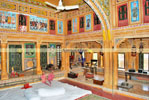
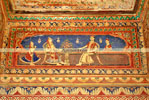
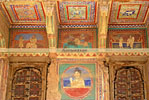
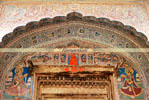
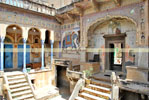
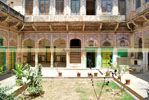
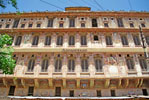
The semi desert region of Shekhawati is a colourful fantasy having a fascinating uniquely of its own. The open air art gallery, as it is popularly called is famous for its plethora of painted havelis, all
commendable pieces of the rich artistic traditional of this region. 'Shekhawati', meanings the land of Shekhs clan derives its name from Rao Shekha (1433 AD - 1488 AD) a section of the Kachhwaha family
of Jaipur. Earlier a part of the former Jaipur state, it now comprises of the districts of Jhunjhunu and Sikar. Initially the region had a blank monochromatic look but with subsequent historical and
social development it has blossomed into a colourful profusion of art and life for almost 2 centuries from 1750 AD to 1930 AD
Shekhawati's magnificent havelis or mansions, built by rich merchants of the region, display a unique architectural style that evolved around the courtyards to ensure safety and privacy of the women
folk and protection from the heat of the long and harsh summers.
The havelis, painted predominantly in the blue, maroon, yellows, green and indigo have beautiful wall paintings that adorn their walls. The earlier wall paintings (1830 AD -1900 AD) were largely based
on the mythological themes, depicting local legends, animals, portraits, hunting and wrestling scenes and a glimpse of everyday life. The turn of the 19th century saw the appearance of new motifs, an
outcome of the Raj's influence upon the Indian culture. Now cars, replaced elephants and traditional Indian miniatures mingled with naturalism of western paintings to produce interesting hybrid results.
The mythological themes depicting gods, lithographs and photographs, Trains, cars, balloons, telephones gramophones English men in hunting attires and portraits of the haveli owners primly dressed were
painted all over the walls-thus making the havelis interesting for both Indian and foreign travellers.
TOP
PLACES OF INTEREST ARE:
Lachhmangarh: Founded in the early 19th century by Raja Lachhman Singh of Sikar, this town is planned on the lines of Jaipur, with roads at right angles and roundabouts. The grant Char Chowk Haveli
is reminiscent of the prosperous Marwari way of life. The fort, Sawant Ram Chokhani Haveli, Mirijamal Kyala Haveli, Bansidhar Rathi Haveli, Kedia Haveli and Sanganeria Haveli adorned with beautiful frescoes.
Churi Ajitgarh: This town is known for the several erotic frescoes painted behind doors, on the bedrooms ceilings and on the walls. Considering the social constructions of that time, these appear
to have been the result of a very private and special efforts. Some examples of fine fresco work are evident in the Shiv Narain Nemani Haveli, Shiv Narain Nemani Baithak, Kothi Shiv Datt, Rai Jagan Lal
Tibrewal Haveli and Ram Pratap Nemani Haveli.
Fatehpur: Founded in the mid 15th century by a Kayamkhani Nawab, Fatehpur's frescoes are unrivalled. The ones done on the walls on the Devra and Singhania Havelis, splendidly combine Indian and Western
styles. These carry inimitable mirror work at the entrance ways, with Japanese tiles carrying Mount Fuji's paintings. The Ram Gopal Mahavir Prasad Goenka Haveli, Hukmi Chand Choudhri Haveli, Jalan
and Bharatiiya Haveli are well worth a visit.
Ramgarh: This town was founded in the late 18th century by the Poddars. The dome of the Poddar cenotaph carries exquisitely painted scene from the Ramayana. The devotedly painted frescoes on the Shani-ji
(Saturn) temple are splendid. Worth seeing are also the Ganga temple, Tara Chand Ghanshyam Das Poddar Haveli, Baij Nath Ruia Haveli and Bagaria Haveli.
Mandawa: One on the most finest of the small towns in the Shekhawati region, this feudal settlement not only has a royal castle, but innumerable havelis where the painted facades offer a great
variety of surprises. Mandawa was founded by Thakur Nawal Singh, a descendant of Rao Shekha after whom the entire region is named. It is today also a major center of a handicrafts and furniture
industry. A painted archway decorated with Lord Krishna and his cowherds leads to the Bazar. The Mandawa Family's collection includes ceremonial costumes and precious arms with handles of
jade. The havelis worth visiting are those of Chokhani, Saraf, Goenka and Ladia.
Lohargal: Lohargal is also a place of tourist because of its natural beauty. This place is associated with Bhim, one of the heroes of the great epic, 'Mahabharat'.
Harsha: Harsha is an ancient village at the base of a hill on which Harshanatha and other temples are located in Sikar district situated around 14 km from Sikar town. Harsha is known for its
famous Shiva temple dating back to the Chauhan period. There is a 10 km. long road which leads one to the mountain, from where one can behold the natural beauty of the villages below. There are
several temples at Harsha, chief among them being the Harsha temple. From the inscription found at the sanctum of the temple, it is evident that it was built by the Chauhan ruler of Ajmer,
Vigrahraj and several changes were made in the temple with the passage of time. Although the temple is now in ruins, one can easily make out that it was once quite unique.
Mukundgarh: Founded in the mid 18th century by Raja Mukund Singh, this is a small town, only 14 km from Mandawa and 2 km from Dundlod in the Shekhawati region. Built around a temple square, Mukundgarh
has a good handicraft market. Besides textiles, the brassware and iron scissors made here are of good quality. The Kanoria and Ganeriwala Havelis carry fine examples o fresco paintings. The Mukundgarh has
been converted into a heritage hotel and in its conversion into heritage property, Cross Country Hotels has retained the atmosphere this 250 years old fort with its charming, painted interiors that
include the typical Shekhawati frescoes.
Dundold: One of the principal feudal principalities of Shekhawati, the havelis of this charming small town are beautifully painted, and some of them are over two hundred years old. These include the
Goenka Haveli that is well known for the exquisite quality of its frescoes.
Nawalgarh: The seat of the Poddar families, among other, Nawalgarh is known for the high quality of its paintings, even in the richly frescoed Shekhawati area. Its Poddar School has some excellent old work, as
well as walls that have been restored in recent times using the same style of frescos for which the region is famous. Nawalgarh was founded in 1737 by Thakur Nawal Singh, a warrior-statesman of
some eminence. The town has a colourful bazaar and a fort, now a little disfigured, yet worthy of attention. There are numerous havelis; prominent among them are the Aath (eight) Haveli Complex,
Anandilal Poddar Havlei, Jodhraj Patodia Havlei, Bansidhar Bhagat Haveli, Chokhani Haveli and Hotel Roop Niwas Palace.
Baggar: Located strategically at a cross-road, Baggar has large reservoir built by the Ojha family. Founded in the 15th century by the Nagar Pathans, Baggar was home for the Rungtas and Piramals.
Chirawa: Lying at a cross-road, Chirawa became popular as a trading town between Jhunjhunu and Loharu. The Havelies worth seeing here are Raj Bahadur Tulsian Haveli, Nemani Haveli, Mangal Chand Dalmia
Haveli, Tara Chand Keshar Dev Dalmia Haveli, Dulichand Kakrania Haveli, Bhola Ram Kakrania Haveli, Manohar Lal Vaidh Haveli, Karkranida Well and Sekhsaria Well. The Dalmias & Kakraniyas grew
wealty on trade and built sprawling havelis here.
Surajgarh: The 18th century fort, in a dilapidated condition and the painted temples and havelis here are the main attraction.
Kajra: The 19th century havelis of the Kajaria family are monuments are worth seeing.
Alsisar & Malsisar: Located on the northern most tip of Shekawati, these towns were founded in the late and mid 18th centuries respectively. The style of the frescoes here and lively colour
combinations are a treat for the eyes. Also the forts in Alsisar & Malsisar, as well as the temples and the Jhunjunwala havelis are magnificent. Besides painted havelis, wells and reservoir with
ornamental traditional architecture are worth seeing in both the villages.
Bissau: Founded in the 18th century, this town has fine havelis including the Sigtia, Khemka, Tibriwal and Kedia Havelis. The chhatris or cenotaphs of the Thakurs are also attractive.
Khetri: Founded in the 18th century, Khetri was the second wealthiest Thikana under Jaipur and is known for the painting adorning the Raghunath Temple and the Bhopalgarh Fort. Sites not be missed are
the Panna Lal Shah ka Talab (water tank), Rama Krishna Mission, Sukh Mahal and Hari Singh Temple. Ajit Sagar, Rameshwar Das Baba ka Ashram at Bassi and Baghore Fort constitute the excursions one
can take from here.
Mahensar: This 18th century town has some fine havelis such as the Sona-Chandi-Ki-Sal and business shops built by the Poddars. The Meenakari work, the figures of birds and floral and tree motifs,
as well as the gilded walls and ceilings leave the spectator amazed. Raghu Nath Temple is another interesting place to visit.
Parasrampura: Parasrampura is a short excursion from Nawalgarh. Here, some of the earliest frescoes dating back to 1750 are painted in the interior of a temple and on the dome of the Chhatri
dedicated to Sardul Singh, a descendant of the founder of the Shekhawati, Rao Shekhaji.
MUSEUMS & ART GALLERIES:
Birla Museum of Science & Technology - Pilani: At Pilani, in the campus of Viday Vihar is located the Birla Museum of Science and Technology. The museum contains the latest science
equipments, models of material science and illustrative diorama, working models, charts & Photographs explaining the principles of the science. It also throws light on the various aspects of
engineering science. Sharda Peeth marble temple dedicated to Saraswati, the goddess of learning also worth a visit.
TOP
FAIRS & FESTIVALS:
Khatu Shyamji Fair: Khatu Shyamji is famous for its Shyamji temple. There is steady stream of devotees the year round. But lakhs of them gather at the annual fair from Phalgun Sudi Dashmi
to Dwadashi. Apart from being a place of pilgrimage, a large number of people come for the Jadula ceremony (the first time all hair is shaved off the head) of their children. Legend connects
the place to the epic Mahabharata war. Krishna, it is believed took the form of a Brahmin and asked for the head of Babhruvahan (Barbrick). He then placed the head on hillock os that it could watch the war.
Pleased with the sacrifice, Krishna, then blessed Babhruvahan to be worshipped as Shyam himself in Kaliyug.
Shekhawati Festival: The Shekhawati Festival held on 10th & 11th Feburary every year is organized jointly by the State Department of Tourism, District administration of Sikar, Jhunjhunu and
Churu, and the M.R. Morarka GDC Rural Research Foundation. Shekhawati, already famous for its frescoes, is fast becoming a rural tourism destination too. Traveling on horse back, the tourists get a
closer view of the countryside and the people. And they return with an indelible imprint of not only the friendliness of the people but also of the agricultural revolution sweeping the villages. The
region now exports 80 percent of its crops whereas only a few year ago it could meet only 10 per cent of its requirement through local production for a broad-based discovery of Shekhawati's culture,
the festival is spread over a number of venues Nawalgarh, Sikar, Jhunjhunu and Churu. The programmes include a one day tour of the region, camel and jeep safaris, farm visits, rural games, cultural
programmes, haveli competitions and fireworks. The driving force behind this festival, the M.R. Morarka GDC Rural Research Foundation, has pioneered integrated rural development since 1993 and has
identified tourism as thrust area for creation of employment opportunities. The festival and other efforts of the foundation have convinced the haveli owner of the need to preserve their priceless
heritage of frescoes.
Nawalgarh is the central venue of the festival and can be reached comfortably by train and road from Jaipur (100 Km.) Nawalgarh also has some of the finest frescoes of Shekhawati.
SHOPPING:
Shekhawati is world renowned and the region is popularly termed as and "Open Air Art Gallery" because of its painted havelies and frescoed walls. Today the tourist can take home a piece of
this art and decorate their walls at home for these traditional murals are being recreated on paper and also on cloth.
Decorate you home like a palace or haveli with the furniture from Shekhawati. The carved and decorated chests, chairs, cradles and low tables & stools are simply a steal. Each object is desirable
whether inlaid with brass sheet work or painted with dancing figures or embellished with hunting scenes. Ramgarh is renowned for the carved Wooden doors & chairs. |