|
A pleasant retreat set amidst the lush forested hills, Mt. Abu is a green oasis in the barren desertscape that's Rajasthan. Situated at the southern tip of the Aravali range the hill retreat owes its cool
climate to its rich flora covering the entire hillside that includes coniferous trees and flowering shrubs. The road leading to Mount Abu is a curved one characterized by arid region dotted
with huge rocks in weird shapes and high velocity winds. The only hill station in Rajasthan, Mount Abu is more than just a summer retreat. Its stunning array of exquisite Dilwara Jain Temples,
dating back 11th- 13th centuries, make it a popular pilgrimage centre. 'Abu' according to a legend, stands for the son of Himalaya, deriving its name from Arbuada, the powerful serpent who
rescued Nandi, the sacred bull of Lord Shiva, from a chasm. Mount Abu has been home to many sages and saints. Most famous of them was Sage Vashishtha who is believed to have created four Agnikula
Rajput clans from a fire-pit by performing a 'yagna' or fire sacrifice, to protect the earth from the demons. The Yagna was performed besides a natural spring situated below Abu, emerging
from a rock shaped like a cow's head and hence the site was called Gaumukh.
PLACES OF INTEREST ARE:
Gaumukh Temple: A natural spring flowing through a sculpted cow's head gives the shrine its name. The famous 'yagna' of sage Vashishtha was performed here. A beautifully sculpted hill temple
of Arbuada - the mighty serpent stands against the beautiful backdrop. Nearby is the magnificent marble image of Nandi, the celestial bull rescued by Arbuada.
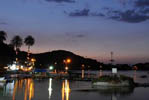
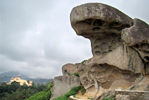
Nakki Lake: To pass and energetic evening rowing or simply to drift along, enjoying nature's beauty, be at the focal point of the town, Nakki Lake. This lovely artificial lake is ringed by hills and overhung
by the enormous Tod Rock. Exploring the lake's little islets is a pleasant recreation. It is said to have been dug by the gods themselves with their nails, hence its name "Nakki". The summer
villas of many Rajput rulers have been converted into hotels overlooking the lake.
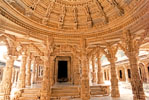
Dilwara Jain Temples: Built between 11th and 13th century A.D, these temples are famous for their superb carvings in marble.
Vimal Vasahi, the oldest temple, was built by Vimal Shah, Minister of Solanki ruler of Gujarat in 1031 AD. It is dedicated to Adinath, the first of the Jain Trithankaras. Made of white marble, it is an outstanding
example of Jain temple architecture.
It has a central shrine, a room with a transept, a large colonnaded area and an aisle consisting of 52 niches with statues of the Tirthankaras in each one. The inner sanctum contains the figure of Adinath in a
mediating posture. The door jambs and lintel are encrusted with carvings. The Neminath Temple was built 1231 AD by the two brothers, Vastupal and Tajpal of the Porwarl Jain Community. A
fine specimen of workmanship, as seen it its carvings, friezes, pillars and sculpted porticos, this temple is dedicated to Neminath, the twenty second Jain Trithankara. A lot of inspiration
and encouragement went into the construction of this temple and rewards of gold and silver, equivalent to the weight of marble covered, were offered to the labourers. The scroll arches are
profusely sculpted and so are the pillars, no two of which are alike. Built in the Solanki style of architecture, this temple has a breathtaking marble pendant hanging liked a crystal chandelier
form the central dome of the porch. It descends from the ceiling like an exotic bunch of half-open lotuses, with such intricately carved cups, that they appear to be transparent.
Adhar Devi Temple: Chiseled out of a huge rock, this temple is one of the favourite tourist spots of Mt. Abu. A climb of 360 stairs leads to the hill, on which this beautiful marble temple is situated. It it
believed that he image of the goddess was originally hanging in mid-air, hence the name Adhar Devi.
Sunset Point: The best Mountain View can be savoured form Sunset Point, south west of Nakki Lake, where the sun gradually drowns itself in the azure sky between two mountain peaks. Steps lead up to a high
terrace which offers an awe-inspiring view of the setting sun.
Honeymoon Point: A rather secluded spot, which looks beautiful at sunset hour. It also presents a pleasant view of the Abu Valley and the green fields on the other side of the mountains. Its older name
was Anadra Point.
Shri Raghunathji Temple: Situated near the 'Nakki' lake is the temple dedicated to Shri Raghunathji with a beautiful image of the deity that was placed here in 14th century A.D. by Shri Ramanand
the famous Hindu preacher.
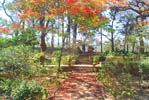
Gardens & Parks: Beautifully laid parks and gardens are interspersed throughout the hilly paradise. Ashok Vatika, Gandhi Park, Municipal Park, Shaitan Singh Park and Terrace Garden are some of
the noteworthy gardens.
TOP
MUSEUMS AND ART GALLERIES:
Government Museum: The only hill station in western and central India Mount Abu has been a center of cultural activity since the pre-historic period. It was the capital of the Parmars
in 13th century AD and later on came under the Chauhans. The museum was set up in 1962 within the premises of Raj Bhawan to preserve the archeological wealth of the region. The first section
has been adorned by a diorama of local tribal hut with their usual living style by adding a gallery of weapons, musical instruments, ladies ornaments like barly, damani, karna, guthma toda, gaga
walal thoomar, kanksi berla, various type of earrings and garments etc belonging to hill dwellers. The second section has a series of miniature paintings based on raga-ragnis, Jain images from Sirohi,
medium sized shields, a small canon called "Topdi" and some pieces of the carvings on local wood. The notable collection of this museum is the finely carved out statues of Devdasi or Nartakis
(Dancer) ranging from 6th - 1 2 century AD procured from an ancient township called Chandravati, 7 kms away from Abu. There is an image of Chakrabau Shiva having a Trishul in one hand and a
Khadag in the other and sitting on Nandi, the bull. On each side of Shiva are dancing girls. In the Abu collection consisting of 404 sculptures, the most distinctive exhibit is the Vish Kanya
(snack goddess) which is 3 feet high. The Sculpture Gallery has some memorial inscriptions collected from nearby areas e.g. Chapa's inscription (local heroine of Achalgarh).
TOP
EXCURSIONS:
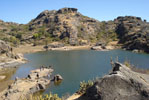
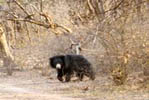
Trevor's Tank (5 km): A part of the forest around Mt. Abu has been turned into a wildlife sanctuary. The road runs through thickly wooded hills alive with peasants, peacocks and partridges. The
hills open out to a clearing which contains a deep pool built by a British engineer, after whom the tank is named. A small forest lodge overlooks the pool. Trevor's Tank is a bird-watcher's paradise.
Achalgarh: A fort, just a little away from Abu, along a motorable road upto Uria. The ascent has to ber made on food through steeply rising woods. Only the ramparts and broken walls remain, of the original
fort built by Rana Kumbha in the 14th century. Palanquins are available on hire for those not in a position to walk. Among the beautiful temples to be seen in the fort are Achaliswar Mahadev
Temple or Lord Shiva Temple (1412 AD), and the Shantinath Jain Temple (1513 AD) which has gold-plated image.
Guru Shikhar: Guru Shikhar is the highest point on the mount & commands a birds eye-view of Abu and the surroundings areas. Temples located in this area are the Mira Temple, Chaumundi Temple & small Shaivite
shrine on the "Shikhar".
FAIRS & FESTIVALS:
Summer Festival: The Summer Festival is held every year in the month of Aashadh (June). The steep rocks, tranquil lakes, picturesque locations and the pleasant climate of Mount Abu make
it an ideal location for the festival.
The three-day festival is a feast of folk and classical music and a window of the tribal life and culture of Rajasthan. The festival begins with the singing of a ballad which is followed by Gair,
Ghoomar and Dhap folk dances which enthrall the spectators. Sporting events such as the boat race on the Nakki Lake add variety to the festival.
The Sham-e-Qawwali is a much-awaited musical extravaganza; as renowned Qawwals from all over the country can be hear regaling the audience. The grand finale of the festival is display of
dazzling fireworks which adds to the tourist's delight. |