Set at the edge of the Thar Desert, the imperial city of Jodhpur echoes with tales of antiquity in the emptiness of the desert. Once the capital of the Marwar state , it was founded in 1459 AD by Rao Jodha, chief
of the Rathore clan of Rajputs who claimed to be descendants of Rama - the epic hero of the Ramayana.
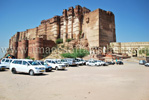
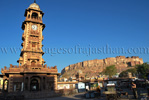
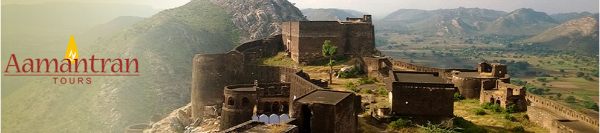
The massive 15th century A.D. Mehrangarh Fort looms on the top of a rocky hill, soaring 125 Mts. Above the plains. The city is encompassed by a high wall -10 km long with 8 gates and innumerable bastions. A
major trade centre of the 16th century A.D. the fortress-city of Jodhpur is now the second largest city of Rajasthan. While the graceful palaces, forts and temples strewn throughout the city bring alive
the historic grandeur, exquisite handicrafts, folk dances music and the brightly attired people lend a romantic aura to the city. The jumbles of wide winding streets are flanked with pavement stalls. The
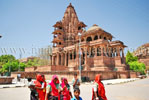
lifestyle in Jodhpur is unusually fascinating with folks wearing lovely multihued costumes, artistically designed. Women folk wear wide gathered skirts and a hip length jacket, with three quarter length
sleeves, covering the front and back. The colorful turbans worn by the men folk add more color to the city. It was from here that the popularity worn baggy - tight, horse riding trousers- 'Jodhpurs' took their name.
TOP
PLACES OF INTEREST ARE:
Mehrangarh: One of the most stunning hill forts of Rajasthan, Mehrangarh appears to rise from the bluff-coloured sandstone hill itself, so well built into the base that it is difficult to tell
where the hill ends and the walls begin. Founded in the 15th century by the Rathore Rajputs when they shifted their capital form nearby Mandore to Jodhpur (or the region known as Marwar), it is approached
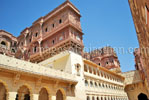
by a series of seven gateways set at an angle so that armies could not charge them with any success. Pass the gates, the fort-palace take one's breath away. Across form huge courtyards are set wings of
palatial apartments that have been built over five centuries of bristling history. Today, managed as a museum by the royal trust that maintains it, only some of the more spectacular palaces of Mehrangarh
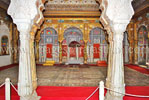
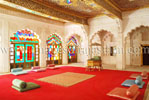
are open to visitors. These consists of Moti Mahal with its pierced screen windows overlooking the coronation seat where the Rathore rulers have been ritually appointed to rule, Jhanki Mahal, the Apartment
from where the zenana women would watch ceremonial events; Chandan Mahal, where affairs of state were discussed; the royal Darbar Takhat or throne room with its octagonal throne; and the Rang Mahal where
the Maharaja would play Holi with his zenana. Also noteworthy are Sheesh Mahal, Phool Mahal, Umaid Vials and Maan Vilas, while a large ten seized from the Mughals in battle is spread for viewing in what
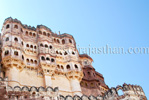
has come to be referred to as the Ten Room. Mehrangarh from the outside is impressive, and certainly forbidding. There is a surprising lightness to it though, once actually within the fort. The builders
seemed to want to make up for the stern austerity of its wall with an overwhelming profusion of windows and jharokas at the upper ends. The effect seems to exaggerate its already impressive height.
Umaid Bhawan Palace: Umaid Bhawan Palace can qualify for several firsts: the largest private residence in the world, the finest extant example of art-deco, the only palace to have painting from
the Ramayana painted by a Polish artist, the first to use air-conditioning, electricity and elevators, and the most impressive for its size and dimensions. Yet, that should be hardly strange, for the
architect, H.V. Lancaster, who planned it, wanted it to rival the Vice Regal Lodge (now Rashtrapati Bhawan) then being planned by Sir Edward Lutyens in the new capital at New Delhi, also then under
construction. For starters, Umaid Bhawan is a formal building that is perfectly symmetrical, and its 347 rooms offer few concessions to Rajput architecture other than such devises as concealed corridors
and balconies for the women of the zenana, and the use of courtyards around which the several wings of the palace are arranged.
Built at the height of the art-deco period, there are several embellishments o n the outer walls, such as the eagle, carved from sandstone. All original fittings have been retained. While many of its
accoutrements are in use, others have been placed in a museum within the premises. Here, you can find out for yourself the fine chine used by the royal family, trace the history of the clocks and
telephones that were once put to use in the different rooms, and discover a bit of your own past in a nostalgia-driven journey through a time not so long ago.
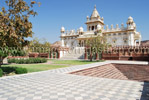
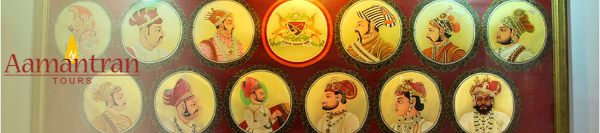
Jaswant Thada: A cluster of royal cenotaphs in white marble built in 1899 A.D. in memory of Maharaja Jaswant Singh II. Within the main cenotaph are the portraits of various Jodhpur rulers.
TOP
MUSEUMS & ART GALLERIES:
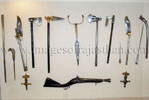
Government Museum: Located in the Umaid gardens on High Court Road, it has a large and fairly interesting collection. There are many stuffed animals, including a number of desert birds in two glass cases,
each with a thorn bush. The military section includes cumbersome wooden biplane models and an extraordinary battleship.
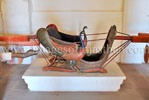
Mehrangarh Fort Museum: This is an excellent museum with rare and interesting artifacts, textiles, paintings, transport items etc. laid out with utmost care and thought. The Palanquin Gallery and
Howdah Gallery display a superb collection of old and costly specimens of great historical value.
Umaid Bhawan Palace Museum: Recently the ruling family of Jodhpur has converted a part of the gigantic Umaid Bhawan Palace as a Palace Museum. The items on display include rare collection of clocks
and watches, fine chine, ornate mirrored furniture, glass and crystal ware, photographs etc. The visitors get access to the grounds and parts of the Umaid Bhawan Palace, one of the largest private
residences in the world.
Government Museum, Mandore: About 8 kms form Jodhpur; Mandore was the capital of Marwar. This enchanting place having beautifully carved cenotaphs, halls of heroes, palaces and old fort, is of
immense historical importance. The Janana Mahal, which was built for the use of royal ladies by Maharaja Ajit Singh (1671- 1724 AD) in Mandore Garden, has been developed as a museum. The Natural History
section has an African Bison and a crocodile of 11 feet. The long Art Gallery exhibits large paintings of Maharajas of Jodhpur and events in their lives. There is a complete section of miniature painting
on Raga-Raganis. The museum also has sculptures of gods and goddess, mentionable among them being the stature of Dancer (12th century AD) and carving of Krishnaleela on one big stone found from Kiradu.
The carving in Devals, Dalan, Chattris and Ek Thamba tower make the Mandore museum and example of excellent architecture.
TOP
EXCURSIONS:
Balsamand Lake and Garden (5 km): A pretty lake built in 1159 A.D. A splendid summer Palace stands by the lake side surrounded by beautiful gardens. An idyllic spot for excursions.
Mandore (8 Km): The former capital of Marwar, north of Jodhpur. Worth seeing are the old cenotaphs and caves in the crags, which once sheltered ascetics. The exquisite landscaped gardens come alive
with peacocks and monkeys and the sprawling greenery of sacred peepal, banyan, bottle-brush, pomegranate, palm & plantains and bubbling fountains are a feast for the eyes. Set against a rocky
wall is a pillared compound, housing the "Hall of Heroes" and "Shrine" of the 330 million gods.
Sadar Samand Lake (55 Km): Rajasthan's village life comes into view on the way here. Chinkara and black buck might frisk past to break the monotony of the drive.
Guda Bishnoi (25 Km): these are immaculately kept villages of the Bishnoi community-staunch believers in the sanctity of plant and animal life. Khejri trees and deer thrive in these village.
Mahamandir Temple (9 km): Built in 1812 A.D. it is noteworthy temple with 84 carved pillers.
Kailana Lake (11 Km): The beautiful lake is an ideal picnic spot.
Jhalamand Garh (10 Km): Barely the 18th century fort has a quiet soothing ambience, and provides a glimpse of the way a Rajput family lives in the rural countryside. From the Dari Khana terrace,
there is a breathtaking view of Jodhpur town. The fort has 18 rooms, and provides Rajasthani and continental cuisine on request.
Luni Fort (35 Km): Now converted into a heritage hotel, this fort and its surroundings are worth a visit.
Osian: Osian, know as Ukeshpur in ancient time, is a land of temples. It was a Brahamanical centre & later, Jainism also flourished here as is evident from the remnants of medieval temples. The Oswal trace
their origin from this place. Osian is a major site, containing monuments spanning five centuries of artistic evolution. There are several beautiful temples and shrines, oldest amongst them being
the Sun temple. The doorway to this temple is one of the finest to be seen anywhere in India. The Harihara I temple, dating back to 750 A.D., is a 'panchayatan' temple, which means that a central
shrine is surrounded by four other smaller ones. It stands on a beautifully decorated terrace with thirteen niches built into its sides. The main temple carries some excellent early figural sculptures
including the Krishna Leela frieze. The Harihara III temple was built around 800 A.D. the walls of its rectangular sanctum carry exuberant decoration, tastefully executed. There is an open hall, the
aisles of which have been provided with a beautiful sloping ceiling supported by rafters, shaped like 'nagas'. Harihara III is one of the finest examples in India of exuberance going hand in hand with
architectural strength. Harihar II adjoining Harihara III is a somewhat less well-finished copy of Harihara I. Apart from this there is the main Sun Temples such as Mahavira temple, Vishnu temples III,
IV, V, which are also worth seeing for their ancient architectural beauty. A unique feature of these temples is that most of them face the west.
TOP
FAIRS & FESTIVALS:
Marwar Festival: The Marwar festival is held every year in memory of the heroes of Rajasthan. The festival is held in the month of Ashwin (Sep.-Oct.) in Jodhpur, for two days during the full moon
of Sharad Poornima. Originally known as the Maand festival, this festival feature folk music centered on the romantic lifestyle of Rajasthan's rulers. This festival is devoted to the music and dance of
the Marwar region and offers a good opportunity to see the folk dancer and singers who assemble here and provide hours of lively entertainment. These folk artistes provide a glimpse of the days of yore,
of battles and valiant heroes who still live on in their songs. Other attractions at the festival are the camel tattoo show and polo. The impressive Umaid Bhawan Palace, Mandore and Mehrangarh fort,
which are symbols of might and valour, provide the ideal venue for the cultural extravaganza an integral part of the festival.
SHOPPING:
A Treasure trove for shoppers, Jodhpur bazaars are teeming with an array of handicrafts. One can shop for white metal curios, silverware, quilts, tie-and-die fabrics, leather goods, wooden toys, paintings,
embroidered shoes, Jodhpur breeches or Jodhpuris and a range of souvenirs.
The main shopping areas are Sojati Gate, Tripolia Bazar, Mochi-ki-Gali and Lakhara Bazar. The Rajasthan Khadi Sangh is recommended for textiles. |