|
A Transition through Time - As you walk along the narrow bylanes of this city of dreams, tread softly. Every crumbling wall has a story to tell. Every yesterday is replete with history. Rulers have come and
gone. The city has lived through wars and resurrection, repeatedly rising from the ashes.
PLACES OF INTEREST ARE:
Safdarjang's Tomb: This marble domed mausoleum was the last famous Mughal monument built in Delhi in 1753-54, by the son of the second Nawab of Oudh. It is a son's tribute to his father, the
Wazir of Mughal Emperor Muhammad Shah.
Purana Quila (Old Fort): Purana Quila, the old fort. The fort was built by the great Afghan ruler Sher Shah Suri in the 16th century A.D. aptly on the banks of the river Yamuna. Now
Boating facilities are available here. A Sound and Light Show depicting 5000 years of Delhi's past is held by Delhi Tourism every evening both in Hindi and English.
Lodi Tombs: Evidence of the sixth city, said to have been built by the Sayyid and Lodi dynasties is found only in the tombs and mosques in the famous Lodi Gardens, which is a favourite point
for early morning walkers from the posh south Delhi colonies
Humayun's Tomb: The Tomb was built by Humayun's widowed Queen Haji Begum, in the 16th century AD. Architecturally the forerunner of the Taj Mahal, it stands in Nizamuddin which shows
the Mughal architecture at its best
Red Fort: Delhi's most magnificent monument, the Red Fort, was built by Emperor Shah Jehan, in 1638 A.D. Enclosed in this glorious Fort is Diwan-i-am, the hall meant for public audiences;
Diwan-i-Khas, where private audiences were granted; Rang Mahal, the water cooled apartment of the royal ladies; the Pearl Mosque, a lovely, ornate dream in white marble. The Prime Minister of
India addresses the nation from this age old Fort, on the auspicious day of India's Independance.
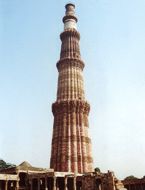
Qutub Minar: The Qutub Minar made of red sandstone rising to the height of 72.5mts is an architectural marvel of the 13th century. Also a must is the visit to Ashoka Pillar dating back to
the 5th century. Though made of iron it has with stood the weathers of time. A very interesting belief is assigned to this pillar- Stand with your back to the pillar, and if you can hold
your hands around it, then make a wish and it will surely come true. Try it!
India Gate: India Gate is a majestic high arch, 42 meters high, built as a memorial to the Indian soldiers killed in the World War I. Beneath it burns an eternal flame. From the base of
the arch one can get a good view of the Rashtrapati Bhavan.
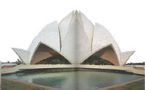
The Bahai's House of Worship (Lotus Temple): This distinctive lotus shaped marvel in marble is surrounded by a landscaped garden and is a symbol of peace.
Ferozshah Kotla: It is the site of the city of Ferozabad built in the 14th century by Emperor Ferozshah Tughlaq. The famous 14-meter highly polished sandstone Ashoka Pillar carrying Emperor
Ashoka's message of peace stands here.
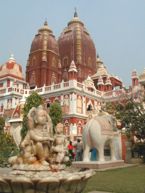
Lakshmi Narayan Temple: Popularly known as Birla Mandir, it is a large Hindu temple built in 1938. People of all faiths can enter and worship but one must walk barefoot into the courtyard
and further on.
Parliament House: This circular shaped colonnaded building houses the two Houses of Parliament- the Lok Sabha and the Rajya Sabha. Its domed Central Hall is 90 feet in diameter.
Chandni Chowk: It is the nerve centre of commercial activity. The narrow lanes have kept alive the traditional workmanship which makes Delhi famous. A market place right from
the times of Mugals, this market still hosts the descendants of royal chefs as also the famous Chudiwali gali and the parathe wali gali. Spend the most enjoyable evening in the Chandni Chowk.
Shahjahanabad: The most splendid of Delhi's old cities, built by Emperor Shah Jehan, is now a part of old Delhi. It was surrounded by a wall 8.8 km in circumference with 14 massive
gates; Five of these still stand: Delhi Gate, Kashmere Gate, Turkman Gate, Ajmeri Gate and Lahori Gate.
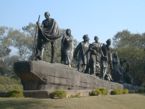
Raj Ghat: On the banks of the river Yamuna is the Raj Ghat where the father of the nation Mahatama Gandhi was cremated in 1948, soon after India attained it freedom.
Jama Masjid: Jama Masjid is the largest mosque in India, and stands across the road from the Red Fort. Built in 1656, it is an eloquent reminder of the Mughal religious fervour. Its spacious
courtyard holds thousands of the faithful who offer prayers.
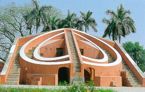
Jantar Mantar: Jantar Mantar is an astronomical observatory with masonry instruments, built in 1724 by Jai Singh, the mathematician and astronomer king. The Samrat or Yantra supreme -
the largest structure shaped like a right-angled triangle, is actually a huge sun-dial; the other five instruments are intended to show the movements of the sun, moon, etc.
Cultural Centre: Mandi House is the nerve centre of cultural activity in Delhi. Close to Connaught Place, the complex has a number of auditoria and cultural institutions where regular
performances take place. The other main cultural centre is the Siri Fort auditorium near the Asian Games Village.
Lal Kot: Lal Kot, a mosque built by Qutub-ud-din Aibak the first Muslim ruler of Delhi, marks the foundation of the Qutub Minar. The first city of Delhi, was built around 1060 AD by the
Hindu Tomar King Anangpal. This was enlarged by Prithviraj Chauhan, the celebrated Rajput. Later, the first Muslim ruler of Delhi, Qutab-ud-din-Aibak, built Quwatul-Islam mosque and laid the
foundation of the Qutab Minar.
TOP
MUSEUMS & ART GALLERIES:
Crafts Museum: The Crafts Museum at Pragati Maidan has galleries displaying India's rich tradition of handicrafts. An added attraction is the presence of craftspersons, who are brought here from
different parts of the country to demonstrate their skills. The museum boasts of having the most rare and exquisite pieces of art and craft, selectively collected from all over the country.
The Crafts Museum kicked off in 1956, as a project to showcase the works of indigenous artisans in one place. By the early 1980's, over 20,000 objects had been collected. The museum is distinct for
its architectural display of various villages.
Authentically constructed mud huts are beautifully decorated with folk art and exhibits include woodcarvings, paintings, paper-mache, embroidery and a full-sized wooden haveli from Gujarat.
The complex also houses the Crafts Museum Shop. The first gallery on display is the Tribal and Rural Craft Gallery, followed by the Gallery of Courtly Crafts, Textile Gallery, Gallery of Popular
Culture, and others. There is also a reference section with about 15,000 objects, for the benefit of scholars, designers and craftspersons.
Live demonstrations by the artisans offer close glimpses of the folk arts of India. Tourists can buy ritual objects, ornaments, rugs, shawls and books from the craftsmen as well as from the museum.
Gandhi Museum: Situated opposite to Raj Ghat is the Gandhi Museum. Dedicated to the Father of the Nation, the museum contains some of his personal belongings.
There are five pavilions one can go through that comprise of sculpture, photographs and paintings of Gandhiji and the history of the Satyagraha movement as well as the philosophy of 'ahimsa' (non-violence).
A stone bowl and a brass plate, the clothes Gandhiji was wearing the day he was assassinated, a pair of wooden sandals are some of the things on display. There is also a library and an information
centre in the same complex.
Indira Gandhi Memorial Museum: The Indira Gandhi Memorial Museum was the residence of the former Prime Minister, Indira Gandhi. It was in this house that she was assassinated by her own
Sikh bodyguards on 31st October 1984. The house was converted into a museum after her assassination.
The museum conserves some of the belongings of Indira Gandhi, including the sari she was wearing when she was assassinated. There is a collection of photographs, which record the Nationalist
movement and the Nehru-Gandhi family.
A modest bungalow, it is furnished simply and hung with photographs narrating her life from childhood days with the Mahatma to later off-duty relaxation with her grandchildren Rahul, Priyanka and Varun.
It is surrounded by a charming garden where you can hear Mrs. Gandhi's speeches from megaphones hidden in the bushes. It was in this garden that she was assassinated.
The spot where Indira Gandhi was assassinated is enclosed in a glass frame. One can still see the dried blood spots.
National Museum of Natural History: The National Museum of Natural History is a small but well-assembled introduction to India's natural heritage and excellent for initiating children
into the study of flora and fauna. A Discovery Room offers children the opportunity to handle specimens and take part in creative activities such as animal modelling.
The National Museum of Natural History (NMNH) is a subordinate office of the Ministry of Environment & Forests, whose basic function is to promote environmental education and create environmental
and conservation awareness among the people through various in-house and outreach activities.
The Museum has various exhibit galleries, a Bio-Science Computer Room, an Activity Room and a Mobile Museum, which are used for promoting environmental awareness among different target groups.
A daily film show is held over here between 11.30am-3.30pm. Regular lectures and exhibitions are also organized in conjunction with other natural history organizations
Shankar's International Dolls Museum: Valley Of The Dolls. One can find just about every kind of a doll one needs to see in Shankar's International Dolls Museum. There are about 6,000 dolls
collected from over 85 countries and a third of the collection has been gathered from different parts of India. Each doll is resplendently dressed in costumes that represent the country or
the region they come from.
The museum is special because it allows a certain kind of a cultural exchange. Through dolls it presents an interesting way to learn about different cultures of various countries. The brilliant
costumes, the varied jewellery of the dolls narrate intriguing stories of different cultures, their climate, their folklore and their mythologies.
There is also a workshop and a Doll Designing Centre in the museum. One can buy dolls from here too. So come and visit this museum and let go the child in you.
Nehru Museum & Planetorium: The residence of Late Jawaharlal Nehru, the first Prime Minister of India was converted into a museum after his death. The museum is a fascinating place
to learn about the history of the Independence Movement. There are several photographs of the erstwhile Prime Minister, giving an account of his life. Besides this, the colonial building is also
equally interesting, with its teak paneled rooms with high ceilings, spacious verandas and well kept gardens.
Nehru Museum was once used to be the official residence of the Commander-in-Chief of the British forces in India before independence. After the departure of the last Commander-in-Chief,
it became the official residence of the first Prime Minister of India, Jawaharlal Nehru. Nehru lived here for 16 years until his death on May 27, 1964. Soon after his death the Government of
India decided that Teen Murti House should be dedicated to his memory and should house a museum and a library.
National Philatelic Museum: Across the road from Patel Chowk, near Connaught Place, is Dak Bhawan, which has a post office with an outlet for philatelists interested in Indian stamps.
The building also houses the National Philatelic Museum, which has an extensive stamp collection including the first stamp issued in India by the Sindh Dak (1854) and stamps issued before Independence
by the rulers of the Princely States.
National Science Centre Museum: A must visit for kids, the National Science Centre Museum has a large collection of working science models, which can be operated by children. So both an
educational and recreational trip can be combined together.
National Museum: National museum is Delhi's largest museum and provides vast storehouse of information of India's history and culture. Packed with exhibits ranging over five thousand years,
one must be prepared to spend several hours here. It is located in Janpath and is closed on Mondays.
The National Museum has an amazing collection of Indian art and sculpture, which dates back from the prehistoric times and the priceless collection is spread over the three floors of the museum.
The ground floor has several galleries, each dedicated to a particular period in history. These galleries display rare pieces from the Paleolithic Age to the Mughal period. The most famous
sculpture on this floor could be the Dancing Girl from Mohenjodaro, 2,500 BC. The Mughal period is depicted and displayed in vivid details in the paintings and Arabian manuscripts.
Of special interest is the superb Central Asian Gallery that exhibits the silk banners, sculpture and wall paintings that form part of Sir Aurel Stein's collection, brought to India in the early part
of the 20th century.
A new gallery has been added to the ground floor, which is the Jewellery section. The first floor contains a varied collection of Indian miniature paintings from different schools, Mughal, Rajasthani
and Pahari. Also catch a glimpse of simple stone Neolithic Tools (3,000-1,500 BC) and shell and bone jewellery excavated from the sites of Mohenjodaro and Harappa belonging to India's earliest
civilization- the Indus Valley (2,500 BC).
Carved pillars and statues of the Mauryan dynasty can also be seen over here. Bronzes from South India, an impressive collection of stone sculpture, miniature paintings, textiles, coins and tribal
art from part of its extensive collection.
The next floor is perhaps the best one, with a terrific display of weapons and costumes of the historical periods. There is a sales counter and library on the ground floor Another section of the
gallery has a display of over 300 musical instruments.
There are film shows on the art heritage of India on weekdays at 2:30 pm, on Saturdays and Sundays at 11:30 am, 2:30 pm and 4:00 pm.
National Rail Museum: A Complete Statistics On Indian Railway Networks. The Rail Transport Museum is a must for rail buffs. There are models of train engines and coaches and it is a train-lovers
delight. Its pride is a model of India's very first train, a steam engine that made its journey from Mumbai to Thane in 1853. The locomotives here are all displayed in the open although there is a
museum as well, which is a storehouse of information on the history of railways in India.
Red Fort Archaeological Museum: Memorabilia From The Mughal Reign. The Red Fort Archaeological Museum is situated in Mumtaz Mahal, Red Fort and comprises of a collection of rare artefacts from
the Mughal period.
A section of the museum is dedicated to Bahadur Shah Zafar. The emperor's personal belongings including his silk robes embroidered with pearls and a silver hookah are on display. Check out the amazingly
crafted swords, hookahs and chess sets, embroidered textiles and decorative blue tiles.
Sanskriti Museum: The Sanskriti Museum is set in the midst of beautifully landscaped gardens in the outskirts of Delhi. The museum comprises of two parts, Sanksriti Museum of Indian Terracotta
and Sanskriti Museum of Everyday Art.
Inspired by the thought of earthen absorption and creativity, the Museum of Terracotta was created by Sanskriti, which houses objects made by some of the finest craftspersons who have visited the Kendra
from different parts of India. Using their distinctive traditions and techniques, they created objects that are displayed in the museum and elsewhere within the complex.
Tibet House: The Tibet house is a must visit for those interested in Tibetian history, an excellent resource centre about Tibet. The House has a collection of artefacts brought from Tibet when
the Dalai Lama fled from there.
There are rare 'Thangkhas' or painted scrolls from 15th century Tibetan monasteries, an exquisite collection of Buddha figurines, old currency notes, objects of prayer, musical instruments and antique
jewellery. There is a library with books on Tibet, Tibetan history and culture. A shop is also located over here that sells clothes, jewellery, medicines, incense, curios and Tibetian handicrafts.
The National Gallery Of Modern Art: Located in the stately Jaipur House the museum has a splendid collection of contemporary art. The National Gallery of Modern Art, housed in the residence
of Jaipur's former maharajas has a superb collection of paintings dating from 150 years ago to the present day. |