|
The Pride and glory of Rajasthan, Chittaur echoes with the tales of romance and valour unique to the Rajput tradition. A ruined citadel, where the royal past lives in its imposing forts, graceful palaces and
spectacular chhatries. This fortified settlement has been ravaged thrice and each time the outcome was 'Jauhar'-when women and children immolated themselves on a huge funeral pyre while men donned in
saffron robes of martyrdom rode out of the fort towards a certain depth. Alauddin Khilji was the first to sack Chittaur in 1303 A.D. overpowered by a passionate desire to possess the regal beauty queen
Padmini. Legend has it, that he saw her face in the reflection of a mirror and was struck by her mesmerizing beauty. But the noble queen preferred death to dishonor and committed 'Jauhar'. In 1533 A.D.,
during the rule of Bikramjeet, came the second attack from Bahadur Shah, the Sultan of Gujrat. Once again Jauhar was led by Rani Karmavati, a Bundi princess. Her infant son, Udai Singh was smuggled out
of Chittaur to Bundi who survived to inherit the throne of the citadel. He learnt from his traumatic childhood that discretion is preferred to valour. So in, 1567 A.D. when the Mughal Emperor invaded
Chittaur, Udai Singh fled to establish a new Capital, Udaipur-a Beautiful lake city, leaving behind Chittaur to be defended by two 16 year old heroes, Jaimal of Bednore and patta of Kelwa. These young
men displayed true Rajput chivalry and died after 'Jauhar' was performed. Immediately thereafter Akbar razed the fort to a rubble. Chittaur was never inhabited again but it always asserted the heroic
spirit of Rajput warriors.
TOP
PLACES OF INTEREST ARE:
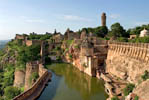
The Fort: Probably India's greatest medieval fort & its most chivalrous, it was from here that the Sisodias went to war against the Mughals at the famous battle of Haldighati. Set on
high plateau, Chittaurgarh sprawls supremely above the surrounding countryside. First established in the 7th century, Chittaur became the Gaddi for the Sisodia rulers who proved themselves indomitable
fighters. Its fortifications meander along the ridges of the hills & from these concealed vantage points, they extended their sway over their kingdom. Chittaurgarh's abandonment led to the ruin to
its palaces and apartments, and its durbar halls.
Little has survived the ravages of the pillaging armies and of time, but there is enough to provide a glimpse of what must have been one of Rajputana's greatest citadels. These include the ruins
of Rana Kumbha's palace as well as what is believed to be Rani Padmini's Palace. Both are in a state of ruin, and there is little that hints at architectural splendour, because many of the
subsidiary buildings and much of the ornamentation no longer exists. Chittaurgarh also houses the palaces, again in ruins, of the brave Sisodia warriors, Jaimal & Patta.
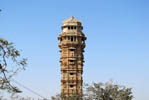
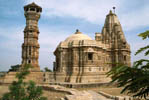
Vijay Stambh (Victory Tower): The imposing 37 meter high structure with nine storeys, covered with exquisite sculptures of Hindu deities and depicting episodes from the tow great epics -
Ramayana and Mahabharatha. It was built in 1440 AD by Maharana Kumbha, a powerful ruler of Mewar, to commemorate his victory over the Muslim rulers of Malwa and Gujarat.
Kirti Stambh (Tower of Fame): The 22 meter high tower built by wealthy Jain merchant in the 12th century AD. The Tower is dedicated to Adinathji, the first of the Jain Tirthankaras and is
decorated with figures of the Jain pantheon.
Rana Kumbha's Palace: The ruined edifice of great historical and architectural interest, being the most massive monument in the fort of Chittaur. The palace is believed to have
underground cellars where Rani Padmini and other women committed Jauhar.
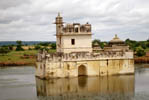
Padmini's Palace: Build beside a pool, the palace is a magnificent one. It was here that Rana Ratan Singh showed a glimpse of queen Padmini to Alauddin Khilji.
Rani Padmini stood in a 'Zanana Mahal' - a pavilion in the centre and her reflection was visible to Alauddin Khilji in a mirror placed in the main hall. After having a glimpse of the legendary
beauty, Alauddin went to the extent of ravaging Chittaur in order to possess her.
Kumbha Shyam Temple: Built during the reign of Rana Kumbha in the Indo-Aryan style, the temple is associated with mystic poetess Meerabai - an ardent Krishna devotee. She was the wife of
Prince Bhojraj.
Kalika Mata Temple: Originally built as a Sun Temple in the 8th century, the temple was later converted into Kalika Mata Temple in the 14th Century AD, dedicated to the mother Goddess
Kali - the symbol of power and valour.
Gardens and Parks: Pratap Park, Meera Park and Nehru Park are beautiful laid out parks in lush surroundings. Beautiful Khwaja rose garden at Saw is just 13 km from Chittaur.
Meerabai Temple: The Temple where Meerabai worshipped Lord Krishna is built in North Indian style on a raised plinth with a conical roof and beautiful inner sanctum. An open colonnade around
the sanctum has four small pavilions in each corner.
TOP
MUSEUMS & ART GALLERIES:
Fateh Prakash Palace Museum: Inside the historical Chittaurgarh Fort, one big portion for Fateh Prakash Palace was converted into a museum in the year 1986. It has great collection
of sculptures. Among the important ones are Ganpati (8th-9th centuries) from Pangarh: Indra and Jain Ambica statues from Rashmi village of post medieval period.
The section devoted to weapons, daggers, armoury, consists of old shields, helmets, axes, farsa, knives and soldiers' uniforms. The clay models of local tribes with their traditional outfits have
also been displayed in a room.
The entire palatial museum has been divided in various sections like archaeology, coins, art gallery, wood crafts of Bassi village, weapons and tribal life.
TOP
EXCURSIONS:
Nagari (20 km): Nagari is an ancient town of archaeological importance. It is 20 kms from Chittaurgarh enroute to Bundi and is situated on the banks of river Bedach. Formerly, the town known as
Madhyamika which flourished from the Mauryan to the Gupta era. Remains of Hindu temples and structures of Buddhist monuments have been found here.
Bassi Village (25 Km): Enroute to Bundi is a marvelous village with historical fort (which now converted into a hotel), temples and kunds. Especially famous are tits sculptures and woodcrafts.
A place of great tourist interest.
Bassi Wildlife Sanctuary (50 sq km): Sanctuary near Bassi supports a population of painters, wild boars, antelopes, mongoose and migratory birds. Prior permission has to be obtained from the
District Forest Officer, Chittaurgarh before visiting the sanctuary.
Sanwariyaji Temple (40 km): On the Chittaur-Udaipur road is a contemporary temple of Lord Krishna, an important pilgrimage spot.
Matri Kundia Temple (50 km): A popular sacred place dedicated to Lord Shiva. Popularly called "Haridwar of Mewar".
Bijaipur (40 km): A marvelous castle built by Rao Shakti Singh, the younger brother of Maharana Pratap, stands in the village. Presently, it has been converted into a heritage hotel.
Sita Mata Sanctuary, Dhariyawad: This thickly wooded jungle sprawls over the Aravalli ranges and the Malwa plateau with three rivers flowing through the forest. According to the legend, Sita,
wife of Lord Rama stayed in this jungle in Rishi Valmiki's Ashram after she was exiled by Lord Rama.
The common fauna that can be sighted here includes leopard, hyena, jungle fox, porcupine, sambhar, wild boar, four horned antelope, nilgai and flying squirrel.
Pratapgarh and Deogarh (125 km): A picturesque route leads from Dhariyawad to Pratapgarh via Deogarh, the old capital of erstwhile State, with its palaces of the 17th century. Another
similar route links Pratapgarh with Banswara. Pratapgarh is known for its Thewa art-gold "inlay" on coloured Belgium glass. As the technique is kept a secret, the art is restricted to a particular
family. Near Arnod, to the south, lies Gautameshvara: a much-renovated ancient temple is located in natural hollow at the foot of a cleft in a mountainous rim.
Menal: 70 kms on the road from Chittaurgarh to Bundi lies Menal, in the district of Chittaurgarh. A place full of natural beauty, Menal is famous for its ancient Shiva temples, picturesque
water falls and dense forests. The word Menal is derived from Mahanal, a great chasm or cleft. Menal was center of art and architecture during the Chauhan period. Chauhan rulers of this
region were followers of Shaivism and because of their patronage Menal became a great center of Shaivism.
The magnificent temple of Mahanaldev, named after this place was build in or around 10th or 11th century AD and is famous for its architecture. Menal is mentioned as a place of pilgrimage in the
Bijolia rock inscription dating VS 1226 (1170 AD) after the reign of Chauhans.
SHOPPING:
The beautiful wooden toys made in Bassi village near Chittaurgarh are the best buys. Besides these, there are Thewa articles of Pratapgarh, printed fabric of Akola and leather mojri of Gengrar.
Favourite shopping spots include Sadar Bazaar, Rana Sanga Market, New Cloth Market, Fort Road Market, Ghandi Chowk and Station Circle. |